Thursday, November 19, 2020

Gordon Matta Clark Exhibit at Whitney walk through with Jane Crawford


Gordon Matta-Clark video here

This video is a retrospective look at Gordon Matta-Clark and his work through the eyes of Jane Crawford, his widow. It took place at the Whitney Museum exhibit of his work in 2007. It was produced by Howard Silver for Bloomberg MUSE. DP was Scott Sinkler, Editor, Seth Karten.

Euthanasia Coaster by Julijonas Urbonas


Euthanasia Coaster by Julijonas Urbonas here

Euthanasia Coaster is a hypothetical euthanasia machine in the form of a roller coaster, engineered to humanely—with elegance and euphoria—take the life of a human being. Design, engineering: Julijonas Urbonas Health issues: Dr. Michael Gresty, Spatial Disorientation Lab, Imperial College, London Model making: Paulius Vitkauskas Photography: Aistė Valiūtė and Daumantas Plechavičius Video: Science Gallery Video footage (human centrifuge training): William Ellis Part of the HUMAN+ exhibition at Science Gallery, Trinity College Dublin, supported by Wellcome Trust, Trinity School of Medicine and the Trinity Long Room Hub. sciencegallery.com/humanplus/euthanasia-coaster The rights to this video do not belong to Thrillmaster Media.

Ronald Rael and Virginia San Fratello (Rael San Fratello) Teeter-Totter Wall


Ronald Rael and Virginia San Fratello (Rael San Fratello) Teeter-Totter Wall video here

Since the early 2000s, architects Ronald Rael and Virginia San Fratello (Rael San Fratello) have developed numerous proposals for interventions and alternatives to the United States-Mexico border wall. Many of their designs were inspired by stories of “people who, on both sides of the border, transform the wall, challenging its existence in remarkably creative ways.” Their work reimagines the wall in ways that range from playful (volleyball net) and infrastructural (solar panels) to natural (cactus wall). “The borderlands have been an evolving context,” as Ronald Rael says. “There was a time when there was no wall. There was a time when the wall was just an idea for national security. There was a time when the wall began to be proposed. And now there's a time when the wall is clearly fixed within our cultural identity.” Recent actions to extend the wall and separate families seeking asylum at the border prompted Rael San Fratello to bring one of their proposals to life. On July 28, 2019, they installed three pink teeter-totters into the border wall for families to play on. Their design serves as a metaphor, as Rael said, of the “border as a literal fulcrum between US-Mexico relations,” with “actions that take place on one side of a teeter totter having direct consequence on the other side.” For an hour, a small section of the wall between the two countries became a site of joyful connection rather than violent division.


Speculative Everything Response

 “Film props have to be legible and support plot development; they have to be readable, which undermines their potential to surprise and challenge.” Speculative props expands our imaginations and provides new perspectives.


“Objects used in design speculations can extend beyond a filmic support function and break away from cliched visual languages that prop designers are often obligated to use.”  Patricia Piccinini’s The Young Family is a perfect example.  She triggers an imaginative response for viewer by creating “a hyper-realistic life-size model of a transgenic creature with vaguely human characteristics suckling her children.  Although the object is presented in hyper-realistic detail, the world it belongs to will be different for each person who sees it.  


It really cleared up the difference of a prop verses a speculative prop when Dunne talked about Barbies and toy guns being props representing real objects, and speculative props being like a box that a chile pretends is a house, or a rock is pretended to be an alien.  Speculative props facilitate imagining and function as “physical synecdoche.”  This enables the viewer to “creatively engage with the props and make them their own.”


“Viewers need to understand the rules of the game and how a speculative design prop is meant to function in a given situation.  This is very difficult because viewers are not used to encountering designed objects with this purpose either in the press or exhibitions.” This statement for me helps to gain some understanding why a lot of people do not appreciate fine art the way art lovers do.  They simple don’t understand the rules of the game.  Many most likely have never even heard the term speculative design and have no idea what it means.  I myself, when viewing an artwork I don’t understand, have never thought of the speculative design perspective.  


Post by India

Monday, November 16, 2020

Responses to Karmel and also Flusser's articles


Karmel and also Flusser's articles


Thomas Demand works in a replica of the places that he heard about them by books, history, and media. For example, Demand's re-creation of the military conference room, the united states president room, and other his works are not a real place. They are fake locations that are not real for him and his audiences, and neither of us believes it. From my point of view, authenticity and mystifications are those meanings that he is looking for in the concepts of history.

He is challenging with stillness and reproductions meanings. He tries to show stillness and presents all moments simultaneously, without human. Even in the assassination’s moment in the Hitler office, his work has a paradoxical meaning with history and we can see the peaceful time, not the explosion mass. We have two groups, first people who see his artwork in the gallery and people, like me, who see the work by websites, and in this scenario, we are in different levels of understanding.  Second, we all are on the same page and our understanding of the Hitler office came from text and old footage. It is possible to say the concepts of Hitler office for all of us is fake.


Original sculptures or stages objects by Thomas Demand are unique, but after taking photos they are become fake for both of us, for him and the audiences. They look different from how they look on the computer screen and websites, in one word, reproductions distort. Even his facsimiles in the gallery are fake too. Look at his works in the gallery by websites, what you are seeing is still not the original. Even the people in front of it can not say they are seeing the original. Then his photos can not be authentic until we consider it as an object. Now his photos for viewers in the gallery are real but internet surfers are still fake. The meaning of authenticity links to our definitions of objects.  In Flusser's articles, he tries to have a classification by definitions of objects. It is about a prediction of artworks in the future. In the not far inaccessible future, images will become pictures showing up on electromagnetic screens. They will delineate a future culture of unadulterated, insignificant data, one in which society will be occupied with expounding what is presently called 'programming'. 

Finally, Uneducated people, until they are educated out of it and are forced to accept mystifications look at images and interpret them very directly. The connect any image whether from comic, news, advertising directly with own experiences. So I sowed them some works of Thomas Demand and they told me it might be a page of furniture’s advertising.

Saturday, November 14, 2020

Thomas Demand, Real Simulation, Vilem Flusser- Photo as Object and John Rajchman, How to Construct The History of Exhibitions


                                 The Real Simulations of Thomas Demand

Thomas Demand makes art in the context of historical events such as war and socio-political issues with the medium of photography and sculpture in a very subtle way. Like Peter Fischli and David Weiss, Thomas Demand stages a sculpture in a form of an unconscious environment and photographs it. In his work Bruno Office, 1996, Thomas displaces blank paper on the floor and table, within an office as a response to the fall of the Berlin War where numerous people were informant. It is fascinating that Thomas instead of him to show photographic images, he rather takes away the evidence of those informants and still maintains the fact that papers hold the great source of memory and  the collective history or image of the society is attained through paper.
Office, 1995


                                        Photo As Object by Vilem Flusser

In the essay Photo As Object, the Vilem Flusser (1986) mentions that humans take upon themselves to preserve memory through photography. The author referenced apparatus as a machine that helps one to manipulate an original object or filter a decision. The apparatus then becomes a critical strategy through which one could create an idea. In the text, he distinguished between the cultural object and the industrial object that the cultural objects already have their shapes or forms and to change them, one needs to understand them before the information that objects carry could be manipulated thus based on the context of the theora whereas the industrial object is based on the praxis, which takes the involvement of experiments and practical evaluations for the user to better understand the function of the object for instance a machine.


                                    Les Immatériaux or How To Construct The History of Exhibitions 

 Jean-François Lyotard  discussion of exhibition references Immanuel Kant’s theory of aesthetics by  creating a dialogue between art and philosophy by analyzing strategies as way form significant history. According to John Rajchman (2009) Les Immatériaux explores new ways of understanding the role of the artist in terms of her/his work in the studio and what the white cube space does to the new work. The decisions that artists make in the process of producing art is mostly the fact of recreating history or creating history. The contemporary art as a culture has expectations of new ideas and strangeness of experience achieved by the audience. 


                       Untitled, 2017 (Exhibition After Life Ahead, 2017)

For instance, Pierre Hughes exhibition After Life Ahead, 2017, the artist created an exterior environment in an enclosed building in Germany. In the building, the viewers are exposed to multiple elements organic and inorganic to be viewed at the same time. It is an empty space and a yet a place full of logical components which create an ideological existence of self within the space through the critical presumptions of the technological and systematic process of those elements. The viewers may feel themselves from exterior to another exterior environment and yet only the wall brings to the viewer, the consciousness of the interior.  An exhibition such as Pierre Hugges's After Life Ahead develops the discussion of an exhibition space in a historical disparity between the modern and post-modern period, emphatically on the white cube space. 

Thursday, November 12, 2020

Damrill_Flusser/Demand_Response

Flusser Response


This author makes a valuable distinction between photographs and objects. Both about the importance and unimportance of each. Flusser deems photographs to only hold information on the surface rather than in the body as objects do. Though if the photographs content hold something of historical significance, of an object that no longer exist, they become important objects as they hold the only essence that object has left. I also am interested in the explanation of an apparatus. This device being a machine that elaborates information. The author refers to an apparatus as a machine that calculates probabilities. He compares this to when human creates and is filled with experiences. These experiences equal intuition when man can predict possibilities. Though this author describes that an apparatus can do this better thus leading to a loss of information for man kind. 


    An artist I believe relates to this writing is Dunne and Raby who use objects or "apparatus's" to bring about thought provoking work. Then the artists uses photography to document these objects.


Dunne & Raby | Domaine de Boisbuchet 


Thomas Demand Response


Demand uses photography to create an alternate reality. A reality that reveals the traces of humanity without showing people creating it. His work is fake and meticulous. Constructed worlds that are loaded with meaningful commentary on events or historical situations. In one photograph, the artist takes Jackson Pollocks studio and omits Pollock himself, his wife and any from of art associated with the artist. This author states that the piece portrays a chapel of sorts “sanctified by light.” This artist utilizes the thought provoking spaces and specifically draws his art from those sections or areas. 


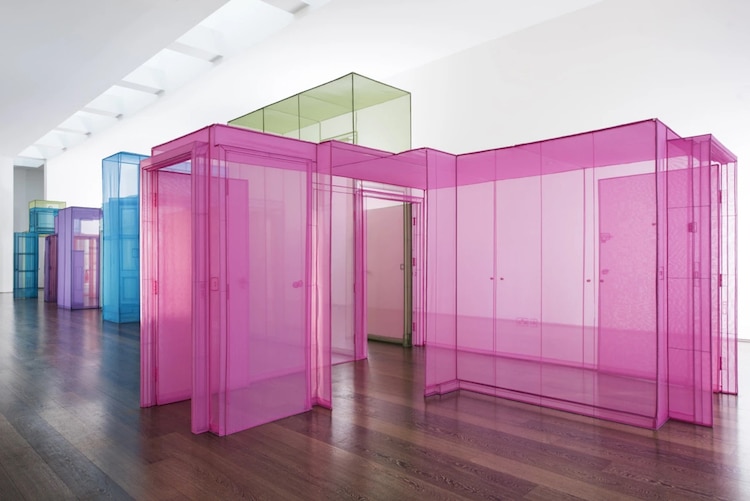
    An artist I believe relates to this writing is Do Ho Suh's installations where he perfectly recreates the internal structure of various rooms and buildings. I believe that taking the essence of a space brings the emotions and memories of that space.


 do ho suh victoria miro gallery